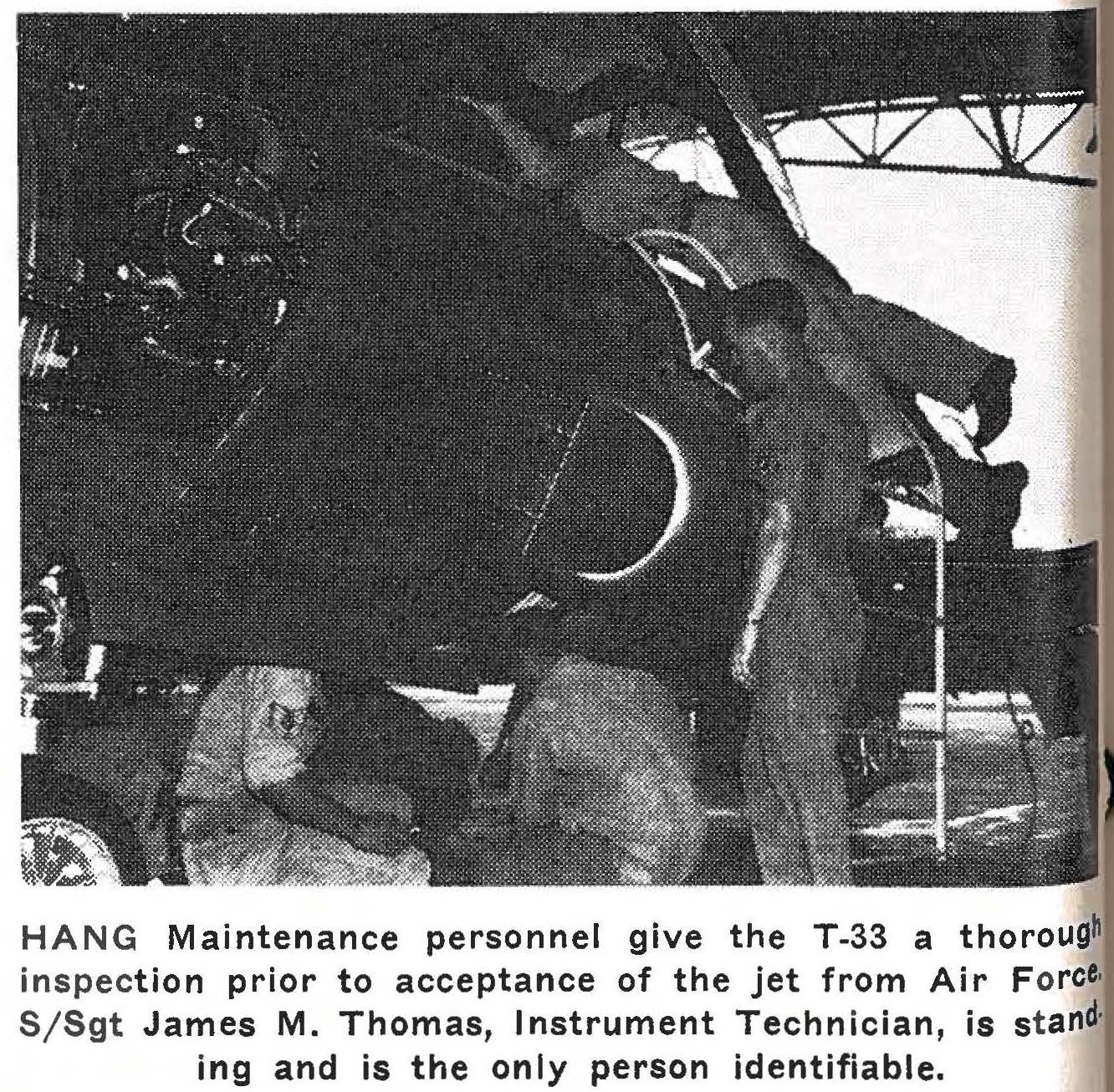
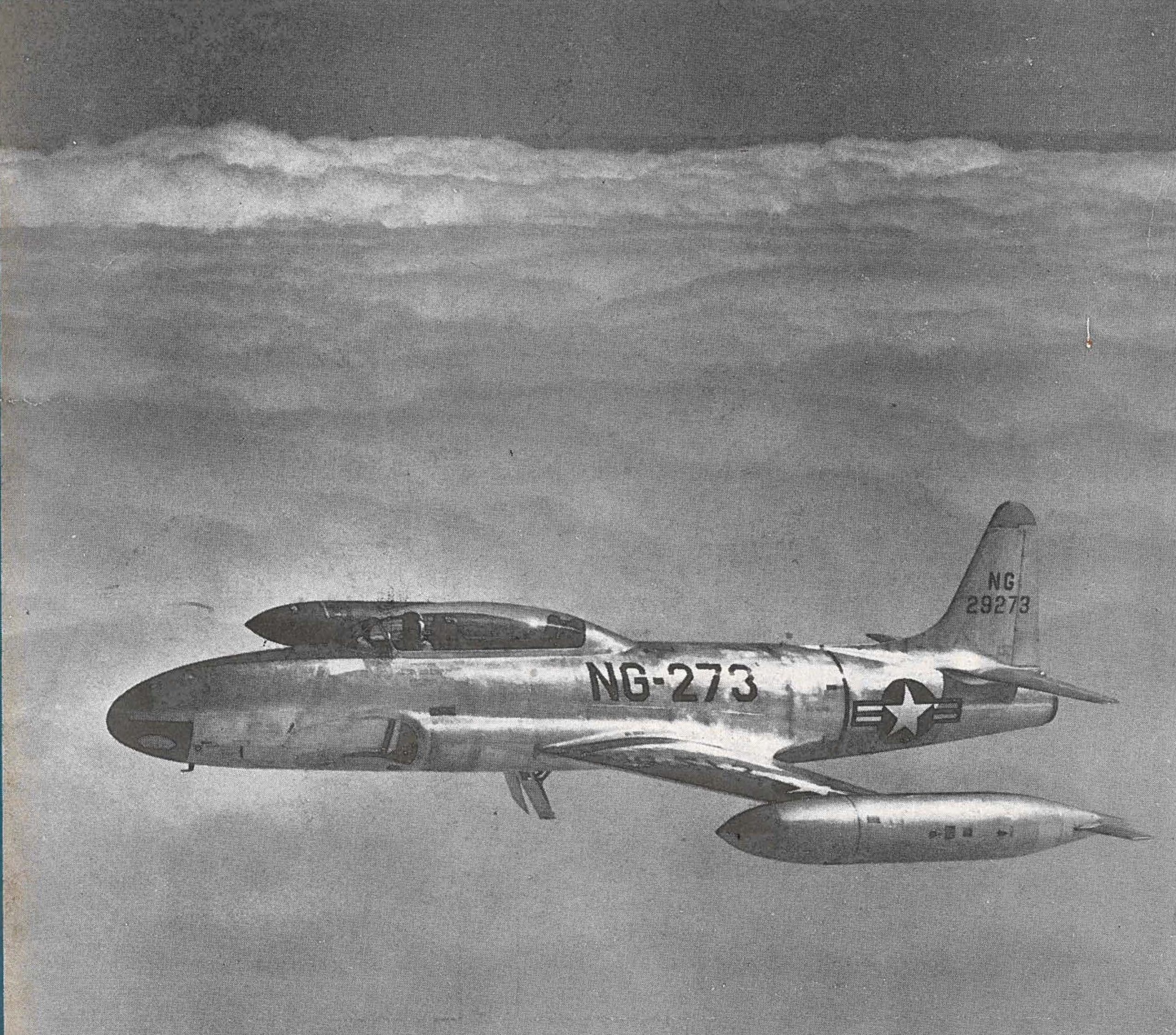
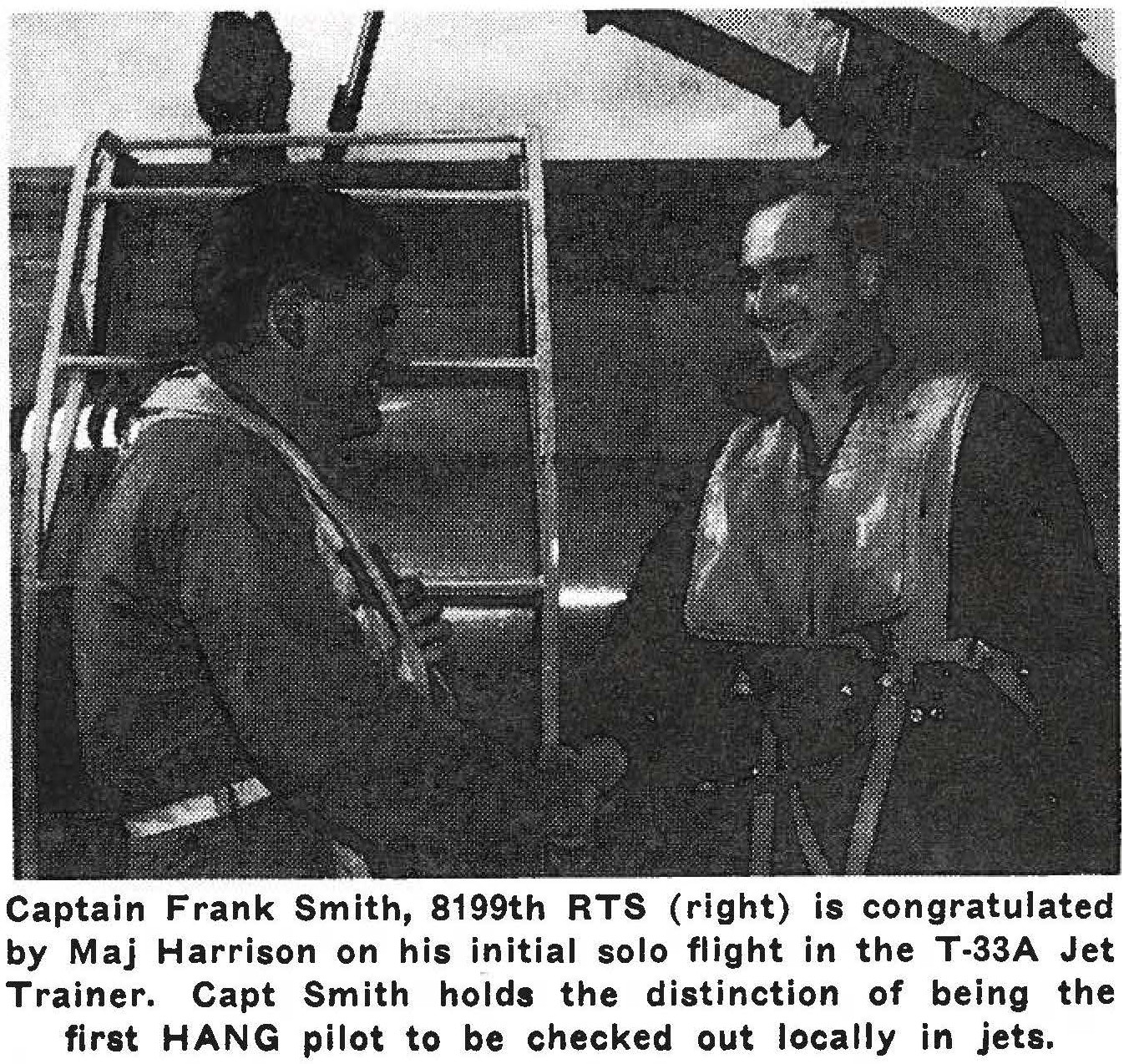
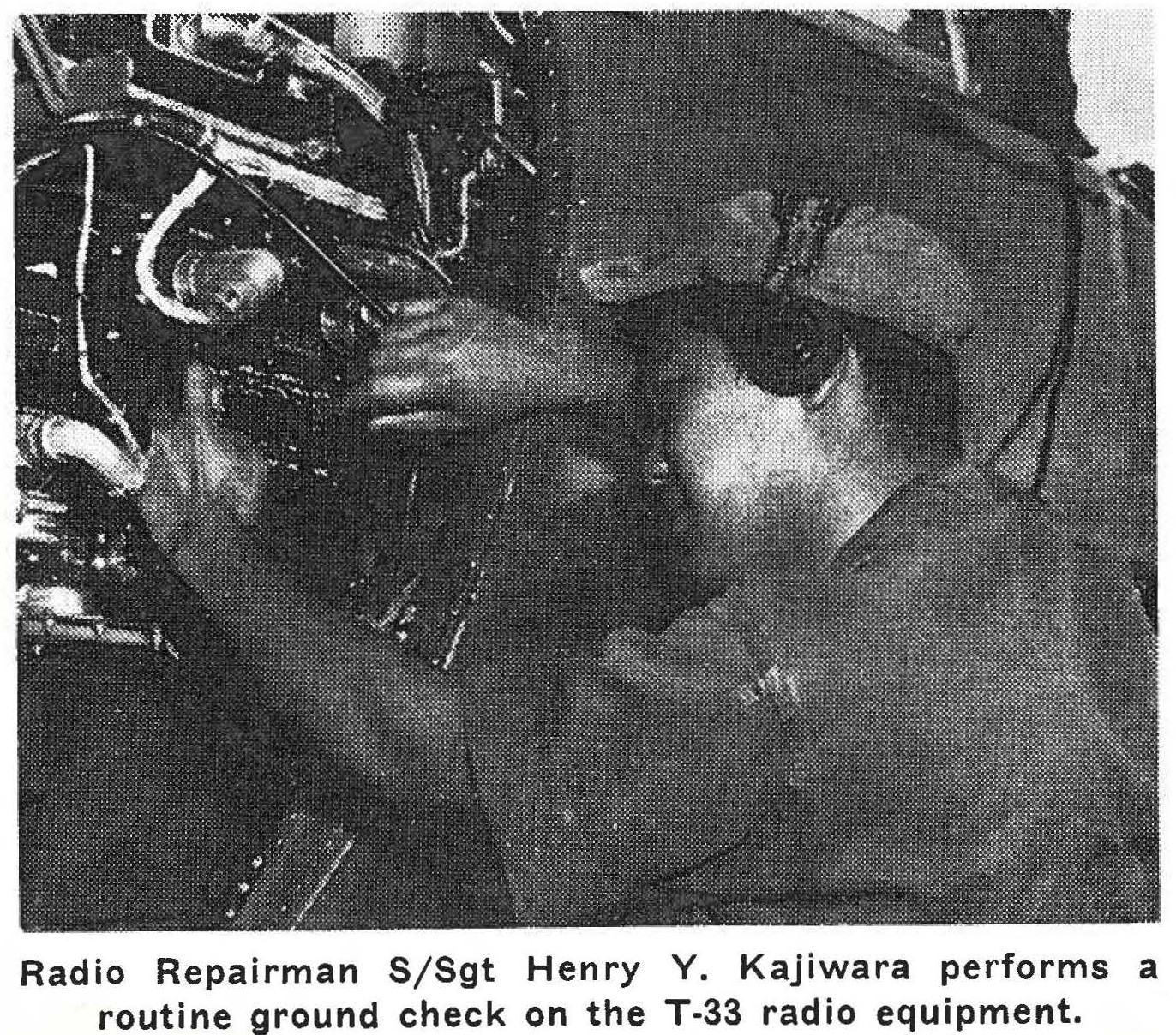
HANG Maintenance personnel give the T-33 a thorough inspection prior to acceptance of the jet from Air Force, S/Sgt James M. Thomas, Instrument Technician, is standing and is the only person identifiable. Major Archibald M. Harrison, Commander of the 199th Fighter Interceptor Sauadron. HANG flys the acceptance check of the first T-33A received by his organization.Captain Frank Smith, 8199th RTS (right) is congratulated by Maj Harrison on his initial solo flight in the T-33A Jet Trainer. Capt Smith holds the distinction of being the first HANG pilot to be checked out locally in jets. Radio Repairman S/Sgt Henry Y. Kajiwara performs a routine ground check on the T-33 radio equipment. (Pictures from the 1954 February Hawaii Guardsmen)
At long last, the Hawaii Air National Guard has received jet aircraft. As a part of the overall Air National Guard re-equipment program, the 199th Fighter Interceptor Squadron, Hawaii Air National Guard, based at Hickam Air Force Base, is being equipped with F-86-E Sabre Jets.
The F-47 Thunderbolts which have served the 199th so well are now on their way out.
Already the first deliveries of Sabre Jets have gone to the 186th Fighter Interceptor Squadron, Great Falls, Montana, and the 190th Fighter Interceptor Squadron, Boise, Idaho. These two tactical units are part of the Air National Guard’s 142nd Fighter Interceptor “Northwest” Wing, which has its headquarters at Spokane, Washington.
More than 200 jet fighters and jet trainer planes, F-80’s, F-84’s and T-33’s, have been delivered to approximately twenty-five Air National Guard fighter-interceptor and fighter-bomber squadrons. Happily, our own 199th Fighter Interceptor Squadron has received its first T-33 jet trainer, and is now a familiar sight in Hawaii skies.
To completely change over from WWII “Jugs” to Sabre Jets of MIG Alley fame is a tremendous program and is one which has and will continue to require the utmost from every member of the Hawaii Air National Guard. And this transition is just the beginning of the program. An operating fighter squadron capable of performing its mission is a beautiful sight. But behind the polish must be the skills and professional qualifications of each officer and airman of the squadron. To change from propeller fighters to jets necessitates that practically all members of the organization learn once again their Air Force specialty. Pilots, Operations, Engineering, Supply, Mechanics, Armament, and so it goes, each section, each individual in the organization must make his own transition to jet aircraft.
To better understand what this transition means, let’s review the re-equipment program of the Hawaii Air National Guard. Perhaps we will be able to appreciate the entire transition more clearly if we cover the main phases at this time.
Let’s begin in the sky with the pilot, for he must be capable of skillfully maneuvering his fighter to bring his guns to bear on the enemy. All energies of the squadron are directed toward making this split-second event possible.
This, for any unit scheduled to receive a new type aircraft, begins several months before the actual delivery date. Ground school courses must be set up. Pilots scheduled to become instructor pilots in the new aircraft are sent to special Air Force schools for training and qualification. Major Arch Harrison, Commander of the 199th, reported to Moody Air Force Base, Valdosta, Georgia, for training as an Instrument Pilot Instructor in the T-33. Here Major Harrison studied the instrumentation of the T-33, Radio Range, Omni, Radio Compass, Applied Instrument Navigation, Instrument Landing Approach Systems and Procedures, Weather Techniques, and flight planning for jet aircraft, along with many hours of classroom instruction, 60 hours of flight and Link Trainer instruction, and over 80 hours of personalized instruction on jet instrument and instruction techniques. After completing this course, Major Harrison reported for the Jet Indoctrination Course, Craig Air Force Base, Georgia, where he received full training in the T-33 Jet Trainer. This training fully qualified Major Harrison as an Instructor Pilot in jet-type aircraft. The course included phases in jet ground and air indoctrination on fuel and electrical systems, emergency procedures, aircraft capabilities, air safety, cruise control, maximum performance maneuvers and operation, formation flying, tactical employment technique, and instrument flying.
Besides Major Harrison, the Senior Air Instructor, Colonel Barry B. Townsend, is a graduate of the jet indoctrination course and is qualified as an instructor. Also, Captain Robert A. Hite, Base Operations Supervisor, 199th Fighter Interceptor Squadron, has returned from Craig as a jet instructor.
Thus staffed, the 199th was ready with a full checkout program with the arrival of its first T-33 in November 1953. By this date the pilots had completed the preliminary ground school and checkout was begun in earnest.
Some months before the arrival of the T-33, all pilots had completed the necessary physiological training required of all jet pilots. In preparation, each pilot attends lectures at Hickam on High Altitude Flying, oxygen equipment of the airplane, and trends in personal equipment. Next came the interesting part of the training. All were ushered into an altitude tank, which is nothing more than a decompression chamber. Once inside, the trainees donned oxygen masks and the ascent began. Climbing to altitude is simulated by pumping air from the tank. The resultant rarefied atmosphere is identical with altitude with only two exceptions: temperature (much warmer), and knowing that the opening of a valve will return us to earth in case of an emergency. The climb to 40,000 feet is taken as serious business, and the instructor making the journey in the chamber and the safety officer looking through a porthole are watchful of each trainee for the first signs of hypoxia, bends, or ear trouble. Any one of these is extremely serious and, in the event of the bends or ear trouble, is excruciatingly painful. Oddly enough, the most dangerous of the three, hypoxia, is not only painless, but one symptom is a feeling of well-being that comes with an attack of hypoxia. This feeling that all is well is soon followed by unconsciousness. Unless oxygen flow is quickly restored, death may result in suffocation or by the crash of the aircraft. It is easy to appreciate the importance of physiological training.
Now comes ground indoctrination of the T-33. Emphasis is given to visual inspection, cockpit check, familiarity with all normal and emergency procedures and operation of the jet engine and systems, bail-out, crash landing over land and water, and care and use of the oxygen equipment.
At long last the jet pilot-to-be is scheduled for his initial flight with an instructor pilot. Each pilot buckles himself in and the engine is started. As the tower clears the aircraft to taxi for take-off, the student realizes a complete absence of engine noise. The hot interphone mike makes conversation normal between instructor and student. Because the mike is “hot,” the sounds of the other pilot breathing are loud and clear.
Take-off clearance is received and the equivalent of over 5,000 horsepower pulls the aircraft quickly off the ground. Most noticeable is the rapid acceleration and terrific rate of climb. Until the student solo flights, he is busy learning all he can about flying characteristics, stalls, climbs, aerobatics, go-arounds, landings, navigation, formation, and altitude indoctrination. Five flying hours are usually required to solo an experienced F-47 pilot in the T-33.
With the first official notification in July 1953 that the 199th Fighter Interceptor Squadron was definitely programmed to receive jets before January, Base Supply was alerted. Supply was the section with the biggest immediate job, and all things considered, theirs was without question the job which was going to be the most difficult. More than six thousand line items of supplies for the F-47 had to be declared excess and shipping documents prepared. While accomplishing this, Hawaii Air National Guard Base Supply will have to requisition and make provisions to receive an equal six thousand separate items for the T-33 and more than a like number for the F-86. A staggering task in itself, it is made even more complicated because the 199th cannot make a sudden transition from one aircraft to another but, rather, the transition will take many months. Therefore, Supply must take into account the supply requirements for each item during the phasing-in and phasing-out period. Consider, too, that Hawaii is on the end of a six-month supply line from the major mainland Air Force depots. Special tools for jet aircraft and ground handling equipment had to be requisitioned. Jet fuel (JP-4) requires its own type of refueling units, for JP fuel is one-third more explosive than regular aviation gasoline. Extreme caution must be exercised at all times, and the proper equipment has to be available when the planes arrive on the base.
The flying equipment for conventional fighters is completely outmoded for jet flying. New types of flying suits, G-suits (for high-speed turns), pressure-type oxygen masks (for protection from hypoxia at altitudes above 35,000 feet)—this is only part of Supply’s job. Much of the hangar equipment is extremely expensive. Special auxiliary power units are required to start jets. The ones we use generate 1,200 amps and cost the U.S. $3,800.00.
On 1 July 1953, the 199th Fighter Interceptor Squadron had only one aircraft mechanic qualified on jet aircraft. This was a matter of the utmost concern to those responsible for the proper maintenance of Hawaii Air National Guard aircraft. After studying the pros and cons, and fully realizing that it would be impossible for Hawaii to be given an exact arrival time of its jet aircraft, a program was decided on which would give us the greatest number of jet mechanics by 1 February 1954. The National Guard Bureau was requested to obtain a quota for ten Air Technicians from the 199th to attend the Jet Fighter Mechanic Course at the USAF Technical School, Amarillo Air Force Base, Texas. The course is a basic course designed to train aircraft mechanics with emphasis on the maintenance and inspection of jet fighter aircraft and engines currently in use by USAF.
In September, ten of our Air Technicians, headed by M/Sgt. Harold T. [surname unclear], Chief Inspector, and M/Sgt. Robert D. W. Choi, Line Chief, reported to Amarillo for this sixteen-week course. A second group of five leave for this course in February. Instruction included airframes, landing gears, flight control, auxiliary systems and equipment, electrical system, fuel, oil, intake and exhaust, and ignition systems, instruments, and jet engines, and engine change. On 1 January 1954, six Air Technicians headed by Major Harrison departed from Honolulu to attend a thirty-day Mobile Training Unit of F-86 aircraft at Gowen Air Base, Boise, Idaho. This course affords a dual purpose in that it offers both pilot and maintenance familiarization on the Sabre Jet. To complete the maintenance picture, the National Guard Bureau has contracted with North American Aviation, Inc., to furnish the 199th with a factory representative during the first months the 199th has Sabres.
When the F-86’s arrive at Hickam they will be depreserved, inspected and made ready for flight by the maintenance personnel of the 1500th Maintenance Squadron. The 1500th has sent several of their top-notch people to a special maintenance course on F-86-E’s in preparation for our receiving these aircraft. In the initial shipment the 199th FIS will receive 15 Sabre Jets, more than enough to classify the 199th as a Jet Fighter Squadron. As the planes are completed by the 1500th Maintenance Squadron they will be turned over to the Maintenance Section of the 199th for final inspection and acceptance.
The big job will begin in earnest with an operational Jet Fighter Interceptor Squadron as the target of all the officers and airmen of the Hawaii Air National Guard.
Upon acceptance of the first Sabre, the immediate task of checking out the pilots will begin. Many more hours of ground school will be necessary, followed by ground familiarization of the F-86, starting and stopping procedures, cockpit check, and then, after the pilot has demonstrated his ability in the T-33, he will be scheduled for the moment that all of our pilots have been so eagerly awaiting—soloing the Sabre Jet.
Providing we are able to meet our schedule, most of the 199th tactical pilots will be checked out in the F-86-E by Summer Camp. If so, then much progress can be made during field training towards developing the tactical proficiency of the pilots. Like a football game, likewise, it will take the efforts of every man in the 199th to weld his organization into a smoothly functioning fighter squadron capable of performing its Fighter Interceptor mission.
All hail the new “Smoke Stack” Squadron. The 199th Fighter Interceptor Squadron now possess a new T-33 Jet Trafoer, the place is really jumping and if you hear a loud drag noise high above your homes don’t get excited and dive under your tables its just the 199th Trade-Mark. In the near future you’ll be hearing more drag in the wild blue yonder when the 199th will be receiving more Jet (F-86) Fighters.
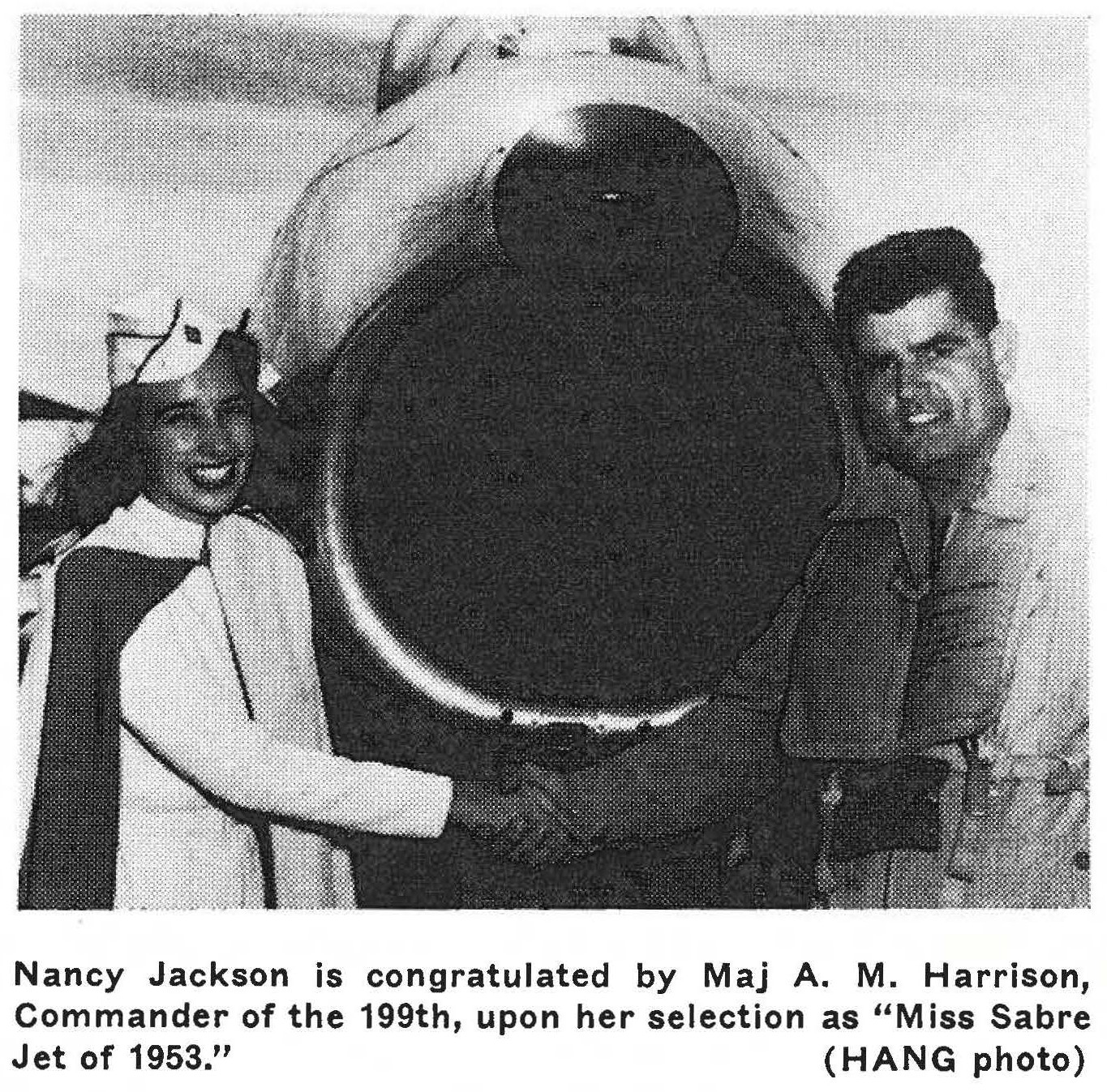
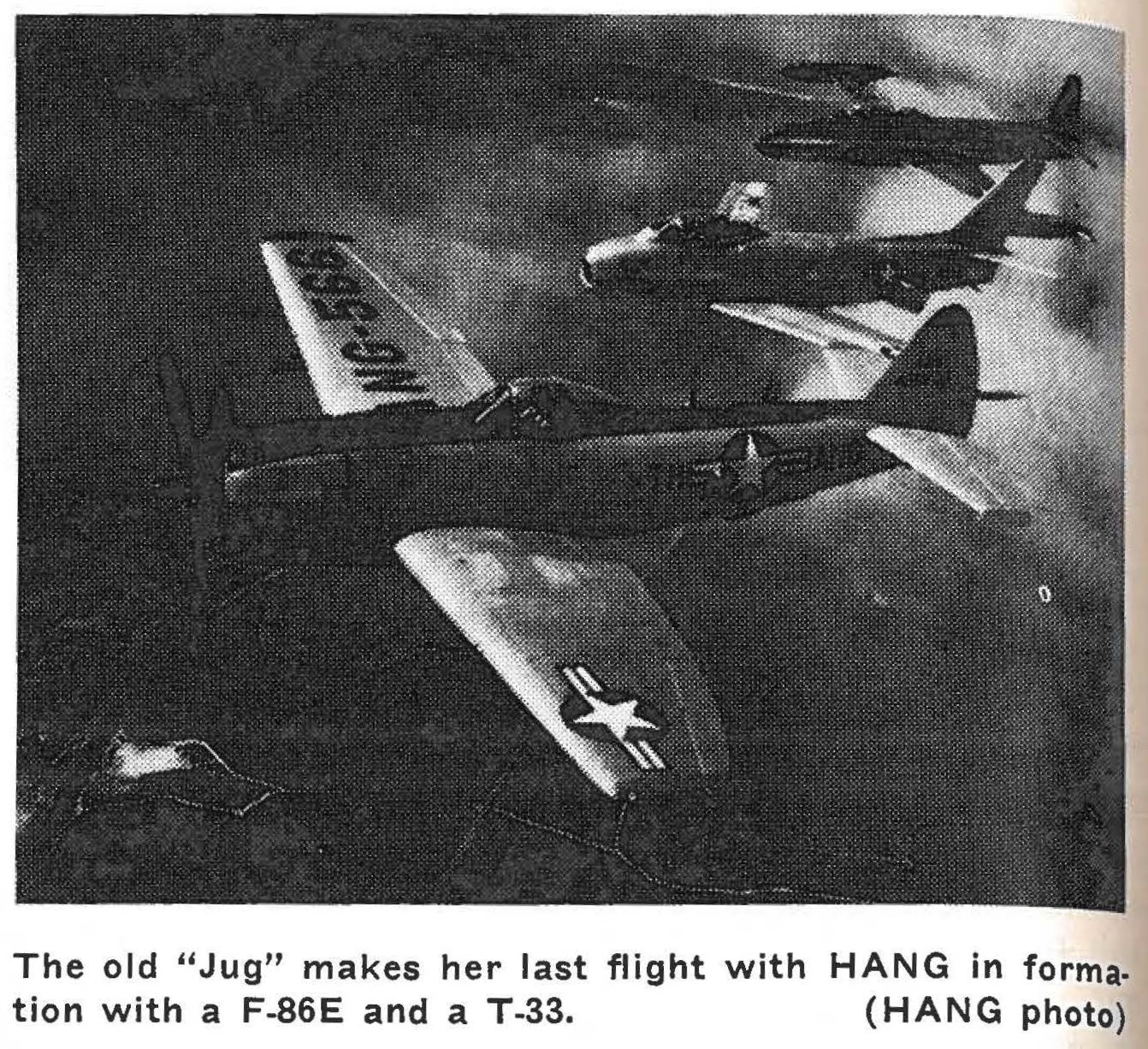
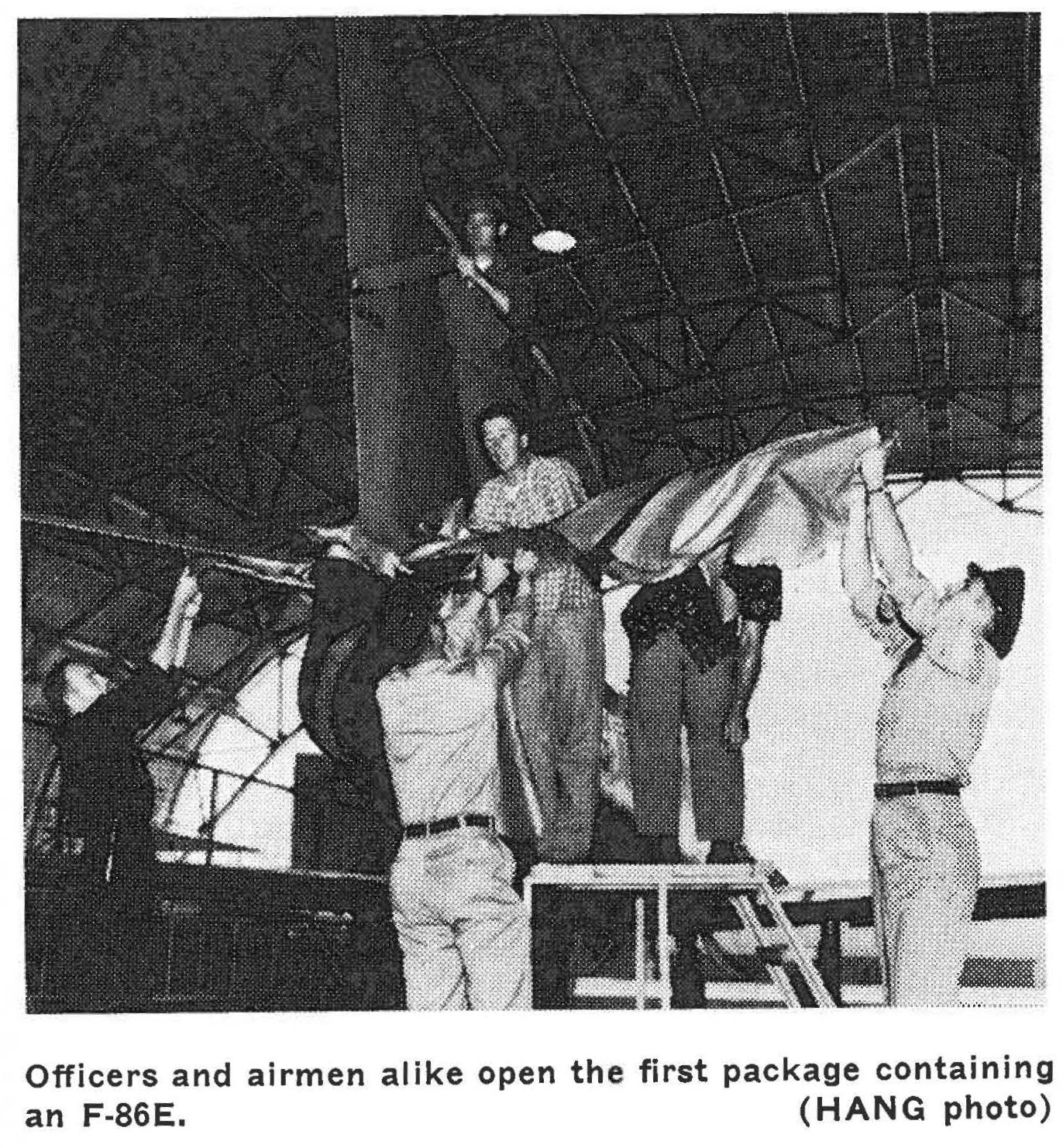
Nancy Jackson is congratulated by Maj A. M. Harrison, Commander of the 199th, upon her selection as “Miss Sabre Jet of 1953.” (HANG photo)The old “Jug” makes her last flight with HANG in formation with a F-86E and a T-33 (HANG photo) Officers and airmen alike open the first package containing an F-86E, (HANG photo)(Pictures from the 1954 May Hawaii Guardsmen)
“D-Day,” popular in use since the Normandy invasion, has become a household word to mark an eventful occasion. But this time I want something more forceful. How about “H-Day”—“H” for history? For the Hawaii Air National Guard, the arrival of the F-86E Sabre Jets is the making of history. Maj. George R. Duncan, Operations Officer of the 8199th Replacement Training Squadron, voiced an opinion that these will be the latest type fighters the Hawaii Air National Guard will ever fly—short of war.
The eagerness of the Air Guard was well displayed by the number of pilots who joined Air Force Reserve, Lt. Col. Brewster Morgan, at the arrival of the U.S.S. Cape Esperance on 10 February 1954. Col. Morgan virtually waded out to meet the carrier as it came into Pearl Harbor bearing supersonic gifts from the East. The unloading of the planes at Hickam Docks was well supervised by pilots grunting and groaning with each sickening lurch of the cradle. The first Sabre lured into the hangar was literally assaulted as Air Guard personnel stripped her of the protective plastic cocoon, revealing one of the Nation’s fastest operational fighters—the F-86E.
The acceptance of the planes by Maj. Gen. F. W. Makinney, Adjutant General of Hawaii, was an important formality. But even before the official ceremony on 17 February, those planes had been accepted by every man in the 199th. It would have taken red blood as well as red tape to remove the Sabres from the field. The fact that number 740, found among the 13 newly acquired ships, was determined to be that of Maj. Jabara, first American jet ace, only added to the pride of possession. Sgt. Afoa of Maintenance, formerly with Maj. Jabara’s squadron in Korea, verified the identification. Although the seven red stars had to go with the application of the HANG markings—the spirit is there.
It was determined that the advent of the F-86 to the Hawaii Air National Guard should not go unnoticed. Forthwith, a public demonstration was started and, like little Topsy, it just grew. One thing led to another until a full-scale air show lay hot and heavy in our hands. Publicity blared forth from every radio and TV station; newspapers were most cooperative. A “Miss Sabre Jet” contest was added, prizes donated, and a squadron dinner held. Out at the field, Lt. Col. V. A. Siefermann, Maj. Arch Harrison, Capt. Robert Hite and CWO Joe Barnett, along with other officers and men, labored diligently. The show was a huge success. The weather turned out perfect, the crowd was good, the exhibits well planned, and despite a faltering auxiliary power unit, Maj. Harrison took off in a cloud of JP-4 fumes to thrill an already excited crowd.
Many thanks are due to the Aircraft Owners and Pilots Association, Hawaii, for its kokua. They arrived with no thought of compensation, the many private pilots with their small planes to take aloft young men interested in signing up with the Air Guard and the “Miss Sabre Jet” contestant. What a wonderful way to demonstrate flying—up in the air! 28 February will long be remembered by many an eager youngster who that day made up his mind that flying was for him.
Problems were encountered. Tools and equipment for servicing the plane were lacking. Poor Richard’s quotation—“For want of a nail a shoe was lost”—was never more forcibly demonstrated. For want of a tool, a jack or a part, a plane was grounded before it ever left the hangar. Lt. Col. Siefermann, with factory representatives, Al Collins from North American and George Kramer from General Electric’s Jet Engine Division, labored hard and long, sometimes improvising where safe to do so, to get those planes into the air. The one and only A.P.U. capable of starting the Sabre Jet was overworked. This is important considering that each pilot checking out must have a tail chase. If there is any delay in starting the second plane, the first is sitting there burning 120 lbs. (20 gals.) of fuel per minute—and without external tanks there is but 30 to 40 minutes of fuel aboard on a capacity filling. At this writing, a second unit has been made available on a temporary basis and there are six more of these auxiliary power units on order.
While CWO Joe Barnett wrestled with the problem of replacing a warehouse full of parts and equipment to meet the demands of the jet aircraft, operations and training had their hands full. Minimum requirements were determined, ground school courses laid out, extensive questionnaires compiled, and the entire scope and thinking of operations changed to embrace the coming of the Jet age in the Hawaii Air National Guard. The pilots were ready and clamoring for more time in the one T-33. Tech Orders were checked out and much midnight oil was burned as informal groups gathered at individual homes to complete seemingly endless questionnaires. Miles per hour changed to knots, gallons of fuel changed to lbs. of fuel, emergency procedures were memorized—not by rote, but by reason—and at once the main topic of conversation changed from statehood for Hawaii to Jets!
The rush for scheduling in the T-33 was phenomenal. It was determined that the pilots checking out in the jet trainer should do so by devoting three consecutive days, morning or afternoon, so that the previous lesson or flight should not grow cold on them. When the “Minute Men” are needed, they can be counted on—and the T-33 was booked solid. From morning till late at night the ship performed beautifully, as if she knew that the boys had to get in their 10 or 20 hours, depending upon previous fighter time, so the next big step could be made—into the F-86, the hero of MIG Alley.
Maintenance and crew chiefs worked doggedly, and always alongside were the two factory tech reps, Al Collins and George Kramer. As hours were built up, so were the F-86s. Then the day came. Sunday double drill, 7 March: Maj. Harrison, trained in Sabres with the ANG, Boise, Idaho, soloed the first Air Guard pilot, Capt. Robert Hite. The tail pipe was not cold before 1st Lt. George Fitzgerald made the big step. Since that day, and in rapid succession, the boys have stepped out and won their gold Sabre Jet pins. Maj. Robert O’Hara, Maj. George R. (Bob) Duncan, Capt. George T. Harris, Capt. Frank Smith, Capt. Robert A. Maguire, 1st Lt. Henry Wilder, and, of course, Col. Barry B. Townsend, USAF, Senior Air Instructor, were the first.
Capt. Willie Dau flew the last old “Jug,” F-47, on Sunday, 7 March double drill. It was timely with the first F-86 solo. Each pilot’s final flight in the F-47 Thunderbolt was done in a different manner. The reaction was varied—from the pilot who said, “I figured it was the last trip in the old Jug and no use taking any chances—I flew straight and level,” to the pilot that “wrung it out as never before.”
So from here on out it’s “Look pop no prop” for the 199th Fighter Interceptor Squadron and her sidekick, the 8199th Replacement Training Squadron. As of 1 April, the hours on the T-33 have sailed past the 400 mark, while those on the F-86 aircraft are passing the 50 mark. Considering that the average local training flight in jet aircraft is not longer than 30 minutes, this is remarkable. By the time summer encampment rolls around, it is anticipated that there will be several pilots with the required 40-hours transition covering formation flying, cruise control, acrobatics, instruments and general proficiency.
These pilots will then go directly into aerial gunnery—contingent upon the presence of a tech rep. A tech rep is necessary since the F-86 uses a new radar gunsight completely different from the one used in the old F-47. The 199th will be sending a man to the mainland for a 10-month course to study this radar gunsight. The other pilots at summer camp will complete their transition.
This transition into jets is not as easy as the funny papers would have you believe. However, if we persevere, some bright, typically Hawaiian day in 1956, an equally bright and typically Hawaiian young pilot with a shiny pair of wings will walk out to one of the swept-wing Sabre Jets on the line, climb in and say to himself, “What did ‘Dad’ in operations mutter when I told him that transition into jets is easy as slipping into an old pair of shoes.”
Fiscal Year (FY) 1954 started off with a bang! The word came down that the World War II vintage JUGs were to be replaced with jets-North American F-86E SABRE JETS of recent Korean War fame, and several dual-place jet trainers, Lockheed T-33 T-BIRDS. Supply was the first to swing into action. It had to determine what was authorized, submit requisitions and prepare to warehouse over 6,000 line items for the TBIRDS and for the SABRE JETs. . .
The tempo of preparations for the forthcoming jets picked up. Ten Air Technicians, headed by MSgt. Robert D.W. Choi (Line Chief) and MSgt. Harold T. Mattos (Chief Inspector), left in October to attend Jet Mechanic School in Amarillo Texas. Maj. Archibald M. Harrison, Squadron Commander: and five Air Technician mechanics attended a 30 day F-86E Mobile Training Detachment course at Gowen AFB, Idaho in January of 1954.
The first T-33 (No. 273) arrived Nov. 12, 1953. The first SABRE JETs came in Feb. 10, 1954 and were greeted by a large, enthusiastic group of HANG members. There were many willing hands to “de-cocoon” them of their sprayed waterproof protective coverings. TSgt. Simanu Afoa, Jr., a Korean veteran, recognized F-86E No. 740 as having been flown by Maj. Jabara, the first American Ace of the Korean War
However, on Feb. 5, 1958, the HANG was authorized to receive the newer F-86L All Weather Fighter Interceptor and with it the responsibility for a 24-hour active air defense commitment. On May 1, 1958, the HANG commenced sunrise to sunset air defense duties with the “Ls”, and the “Es” were phased out by May 30, 1958.
EIN Presswire provides this news content "as is" without warranty of any kind. We do not accept any responsibility or liability
for the accuracy, content, images, videos, licenses, completeness, legality, or reliability of the information contained in this
article. If you have any complaints or copyright issues related to this article, kindly contact the author above.